Aircond Dry Mode vs Cool Mode Malaysia — Which Saves Power?
Dry mode vs cool mode on your aircond remote: what each setting actually does, when Malaysia's humidity makes Dry the right choice, and whether it really cuts your TNB bill.
The water droplet button and the snowflake button on your aircond remote are not two names for the same thing. Choosing between them is the difference between a room that feels dry and comfortable and one that is cold but clammy — and, on the right day, the difference between a sensible TNB bill and a surprising one.
What Dry mode actually does
In Dry mode the indoor fan runs at low speed and the compressor runs in short cycles, just enough to keep the evaporator coil cold. Humid room air passing over that cold coil gives up its moisture as condensation, which drains away through the pipe, and the drier air returns to the room. The goal is dehumidifying, not chilling — you may notice a 1–2°C drop, but do not expect the room to become cold.
In Cool mode the priority is the opposite: the compressor works to reach your set temperature, running harder and longer until it gets there, with dehumidifying happening only as a side effect. (And Fan mode, for clarity, runs the fan with the compressor off — it neither cools nor dries.)
Dry mode vs Cool mode at a glance
| Dry mode | Cool mode | |
|---|---|---|
| Main job | Remove humidity | Reach the set temperature |
| Compressor | Short cycles, low load | Runs until set temperature is met |
| Fan | Low speed (often fixed) | Adjustable speed |
| Best for in Malaysia | Sticky, humid, mild days and nights | Hot afternoons and direct-sun rooms |
| Typical power draw | Usually lower in the right conditions | Higher — the compressor does the real work |
| Will it cool a hot room? | No — switch to Cool | Yes |
When Dry mode is the right choice in KL & Selangor
- Rainy-season and inter-monsoon evenings, when the temperature may be a bearable 26–28°C but humidity makes the air feel heavy. Drier air at 27°C feels more comfortable than colder, damper air.
- Damp mornings after a night of storms, when the room feels musty rather than hot.
- Overnight sleeping for people who find Cool mode over-chills the bedroom by 3 AM.
- Rooms that fight mould — keeping indoor humidity near or below roughly 60% slows mould growth, which complements the habits in our mould prevention guide.
When Dry mode works against you
- Hot afternoons. If the room is genuinely hot, Dry mode will cycle without ever reaching comfort, and the unit can run longer for no benefit. Use Cool mode and a sensible set point — see our electricity bill tips.
- Undersized or tired units. A unit that is already struggling to hold temperature will not dehumidify well either.
- A clogged coil. Condensation needs clean fins and good airflow. A coil caked with dust and film sheds moisture poorly, so Dry mode dries little and can even smell. This is a cleaning job, not a settings job.
Does Dry mode really save electricity?
Sometimes, and the honest answer is "it depends". Because the fan runs low and the compressor cycles, Dry mode generally draws less power than Cool mode on humid-but-mild days. Our own aircond electricity calculator assumes a 1.5 HP non-inverter unit draws around 1,200 W while the compressor runs — at the site's default blended domestic rate of 50.9 sen/kWh that is roughly RM 0.61 per hour of full-compressor running. Anything that shortens or lightens compressor time, like Dry mode on the right kind of day, cuts that figure. On a hot afternoon, however, Dry mode never reaches comfort and the saving disappears; and on a fixed-speed non-inverter unit the compressor draws near full power whenever it is on, regardless of mode. Treat Dry mode as a comfort tool that saves energy in the right weather — not a permanent "cheap setting".
The coil is the real humidity engine
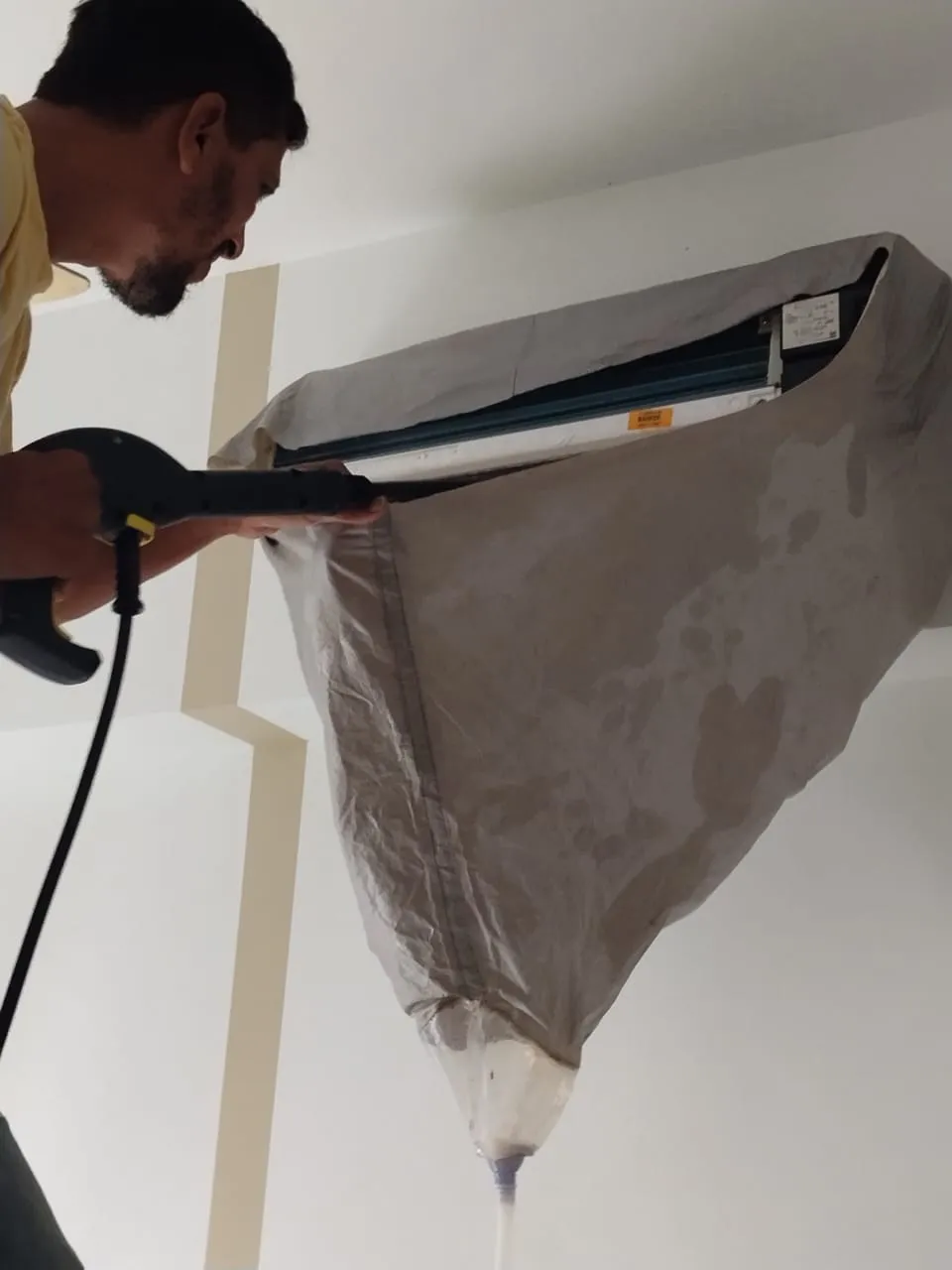
Both modes depend on the same hardware: a clean evaporator coil and a clear drain. When the coil is dirty, cooling weakens, condensation drops and the musty smell returns — in every mode. That is why a room that "used to dry nicely" usually needs a service, not a new remote trick. A Basic Servicing from RM 99 restores filters and checks the drain, while a Deep AC Chemical Wash from RM 120 clears the coil itself. If the unit also blows warm or drips, our service chooser will point you to the right fix.
Book a check before the next monsoon
WhatsApp +60 18-298 3573 with your unit type and what you are feeling — sticky air, weak cooling, smell or dripping — and we will confirm a slot and a fixed quote before any work starts. Same-day slots are often available across KL & Selangor, Monday–Sunday 9:00 AM–6:00 PM. You can also book online or find us via near me.
Frequently asked questions
Does Dry mode cool the room?
A little. Dry mode keeps the coil cold enough to condense moisture, so the room may drop 1–2°C, but cooling is not its goal. If the room is hot — a KL afternoon after 11 AM — use Cool mode.
Does Dry mode save electricity in Malaysia?
Usually yes on humid but mild days, because the fan runs low and the compressor cycles instead of running flat-out. On a hot afternoon it will not reach comfort and can run longer, so the saving disappears. Behaviour also differs between inverter and non-inverter units.
When should I use Dry mode in KL & Selangor?
On sticky evenings, rainy-season nights and damp mornings when the temperature is around 26–28°C but the air feels heavy. That is exactly the Klang Valley condition during the year-end monsoon and the inter-monsoon storms.
Is Dry mode the same as Fan mode?
No. Fan mode only circulates air with the compressor off — it neither cools nor dehumidifies. Dry mode runs the compressor in short cycles to pull moisture out of the air.
Can I sleep on Dry mode all night?
Yes, many people find it comfortable overnight because it removes the stickiness without over-chilling the room. If you wake up with a dry throat or the room feels too cool, switch the set temperature up a degree or use a sleep/timer feature.
Why is my room still sticky on Dry mode?
Three common reasons: the room is too hot for Dry mode to matter, the unit is undersized, or the evaporator coil is clogged so it cannot condense moisture properly. The third one is fixed by a basic service or chemical wash, not by any remote button.
Does Dry mode prevent mould?
It helps. Mould grows fastest above roughly 60% relative humidity, and Dry mode keeps the room drier. It does not clean mould that is already on the blower or coil — for that you need a chemical wash.
When should I call a technician instead of changing modes?
If the unit blows weak or warm air in every mode, drips water, or smells musty, changing modes will not fix it. Book a check — basic servicing starts from RM 99 and a pressure chemical wash from RM 120.
Definitions
Key terms in this guide, explained
Short, plain-language definitions of the terms used above — written by the technicians who do the work, not copied from a manufacturer brochure.
Basic servicing — what is the technician checking?
Basic servicing is the maintenance visit: filters washed, front panel and louvres wiped, drain path flushed, outdoor coil brushed, and cooling temperature plus running current checked before the technician leaves. It keeps airflow and efficiency stable but does not strip mould off the coil. Published price starts at RM 99 per 1.0–1.5 HP unit.
Every 3–4 months is the realistic interval for a bedroom unit in KL; stretch it and the next chemical wash gets harder, not cheaper.
What is the indoor coil, and why does it get dirty?
The evaporator is the finned coil inside the indoor unit where cold refrigerant absorbs heat and moisture from the room air. Because it is permanently wet during operation, it is where mould, bacteria and dust bind together into the grey film that causes the sour smell and the drop in airflow. Filters catch the coarse dust; the coil holds the rest.
If the airflow feels weak right after a filter wash, the coil — not the filter — is the blockage, and that needs a chemical wash.
What is dry mode good for in Malaysian humidity?
Dry mode runs the compressor in short low-fan cycles so the coil keeps condensing moisture without over-chilling the room. On a wet Klang Valley evening it can make a 25 °C room feel more comfortable than 22 °C on cool mode, at lower power. It is not a substitute for a dehumidifier in a damp store room, because the unit still stops once the temperature target is met.
Use dry mode on rainy evenings and keep cool mode for the hot afternoon — the switch alone shaves running hours off the compressor.
Side-by-side comparison
Inverter vs non-inverter: which pays back in your home?
The honest answer depends on how many hours a day that particular unit runs.
| What to compare | Inverter | Non-inverter |
|---|---|---|
| Running cost, 8 h/night | Noticeably lower once the room is at temperature | Higher — full-power restarts all night |
| Short 30–60 min use | Little advantage | Perfectly adequate |
| Repair parts | PCB-dependent, dearer boards | Simple, cheap, widely stocked |
| Voltage-fluctuation tolerance | Sensitive — surge protection matters | More tolerant |
In short: Inverter for bedrooms that run all night; non-inverter is still the rational choice for a guest room or a shop that cools in short bursts.
Quick answer
KL Renovator's practical answer: Dry mode vs cool mode on your aircond remote: what each setting actually does, when Malaysia's humidity makes Dry the right choice, and whether it really cuts your TNB bill.
Reader FAQs
Does Dry mode cool the room?
A little. Dry mode keeps the coil cold enough to condense moisture, so the room may drop 1–2°C, but cooling is not its goal. If the room is hot — a KL afternoon after 11 AM — use Cool mode.
Does Dry mode save electricity in Malaysia?
Usually yes on humid but mild days, because the fan runs low and the compressor cycles instead of running flat-out. On a hot afternoon it will not reach comfort and can run longer, so the saving disappears. Behaviour also differs between inverter and non-inverter units.
When should I use Dry mode in KL & Selangor?
On sticky evenings, rainy-season nights and damp mornings when the temperature is around 26–28°C but the air feels heavy. That is exactly the Klang Valley condition during the year-end monsoon and the inter-monsoon storms.
Is Dry mode the same as Fan mode?
No. Fan mode only circulates air with the compressor off — it neither cools nor dehumidifies. Dry mode runs the compressor in short cycles to pull moisture out of the air.
Can I sleep on Dry mode all night?
Yes, many people find it comfortable overnight because it removes the stickiness without over-chilling the room. If you wake up with a dry throat or the room feels too cool, switch the set temperature up a degree or use a sleep/timer feature.
Why is my room still sticky on Dry mode?
Three common reasons: the room is too hot for Dry mode to matter, the unit is undersized, or the evaporator coil is clogged so it cannot condense moisture properly. The third one is fixed by a basic service or chemical wash, not by any remote button.
Does Dry mode prevent mould?
It helps. Mould grows fastest above roughly 60% relative humidity, and Dry mode keeps the room drier. It does not clean mould that is already on the blower or coil — for that you need a chemical wash.
When should I call a technician instead of changing modes?
If the unit blows weak or warm air in every mode, drips water, or smells musty, changing modes will not fix it. Book a check — basic servicing starts from RM 99 and a pressure chemical wash from RM 120.
Reviewed by real technicians
KL Renovator's HVAC Expert Team
This article links back to the same field team that services wall-mounted, ceiling cassette and window units across KL & Selangor. Meet the 4 real technicians behind KL Renovator, see their experience, and review our service standards before you book.