Post-Haze Aircond Cleaning Guide Malaysia
Haze coats aircond filters and coils in fine PM2.5 dust. What smoke haze does to your unit, and the post-haze cleaning checklist for KL & Selangor homes.
Haze in the Klang Valley is not only an outdoor-air problem — it also lands on the machine that circulates your home's air. When PM2.5-laden smoke drifts in through open windows, doors and gaps, the aircond's filters and coil are the first surfaces the fine dust settles on, while the outdoor unit is exposed to the same smoke on the ledge. This guide explains what haze actually does to each part, what you can safely do while the haze lasts, and the correct way to clean the unit once it clears — using only KL Renovator's published prices for KL and Selangor.
How haze dust gets into your aircond
PM2.5 refers to particles smaller than 2.5 micrometres — small enough to drift through an open window, a doorway or a wall gap, and far more numerous in the air than the visible haze suggests. A wall-mounted split unit does not pull in outdoor air while the room is sealed: it recirculates the air already inside. That means haze enters when you ventilate, and the aircond then keeps moving that dusty air through its internal parts every time it runs.
The mesh filter is designed for coarse dust and pet hair. It traps a fraction of PM2.5, but the rest passes through and settles on the evaporator coil, the blower wheel behind the panel, and the dark, humid drain pan. Add Malaysia's humidity and the soot binds into a fine grime layer that a casual wipe never removes. Meanwhile the outdoor condenser sits exposed on the ledge or wall bracket, collecting the same soot on its fins all season long.
What haze does to each part of the unit
| Component | What haze leaves behind | What happens if left uncleaned |
|---|---|---|
| Mesh filter | Fine grey film of soot mixed with dust | Airflow across the coil drops and the unit works harder to hold temperature |
| Evaporator coil | Stuck-on fine dust that binds with humidity into a biofilm layer | Heat exchange degrades, cooling weakens, electricity use rises |
| Blower wheel | Dust and mould in the fan vanes | Musty smell, uneven airflow, possible wobble noise |
| Drain pan and pipe | Organic film in a dark, humid channel | Slow drainage that ends in dripping or leaking from the indoor unit |
| Outdoor condenser | Soot layer over the aluminium fins | Heat rejection gets worse, the compressor works harder and the unit runs hotter |
None of this is an instant breakdown. It is an acceleration: the same fouling every aircond accumulates in a humid climate, only arriving sooner in haze months. A coil left uncleaned for long enough can lose 15–40% of heat-exchange capacity as grime builds on the fins — which is why a post-haze check is worth doing even when the unit still feels cold.
What to do during haze — the safe DIY part
Rinse the filters every 1–2 weeks
Normally a mesh filter is rinsed every 2–4 weeks. During heavy haze days, halve that interval. Switch the unit off (or remove the plug), take the filters out, rinse them under running water, shake off excess water, dry them completely in the shade and refit. A filter that is reinstalled damp will re-dust the room. This takes about ten minutes and costs nothing.
Keep doors and windows closed — and run the aircond
Because a split unit recirculates indoor air, a sealed room keeps its existing air circulating without replacing it with fresh haze. Running the unit during a high-PM2.5 day is generally the more comfortable and the more sensible choice for the room air you already have.
Be honest about one limit: the mesh filter is not a PM2.5 filter. It will not scrub smoke out of the air. If outdoor haze is the main health concern, a HEPA-class air purifier is the tool for that job; the aircond's job is cooling and comfort, with filter care as its contribution to air quality.
Keep the outdoor unit clear
Check that nothing is leaning against the outdoor unit and that leaves, plastic bags or debris are not covering the fins. You do not need to — and should not — clean the condenser yourself while the unit is powered. A professional service includes a proper fin clean.
Do not leave it off for weeks
In a hot, humid climate, a unit that sits powered-off for weeks lets mould establish in the drain pan and behind the coil. Run the unit for a short session after heavy haze days so the internal parts stay dry.
The post-haze cleaning checklist — what a technician actually does
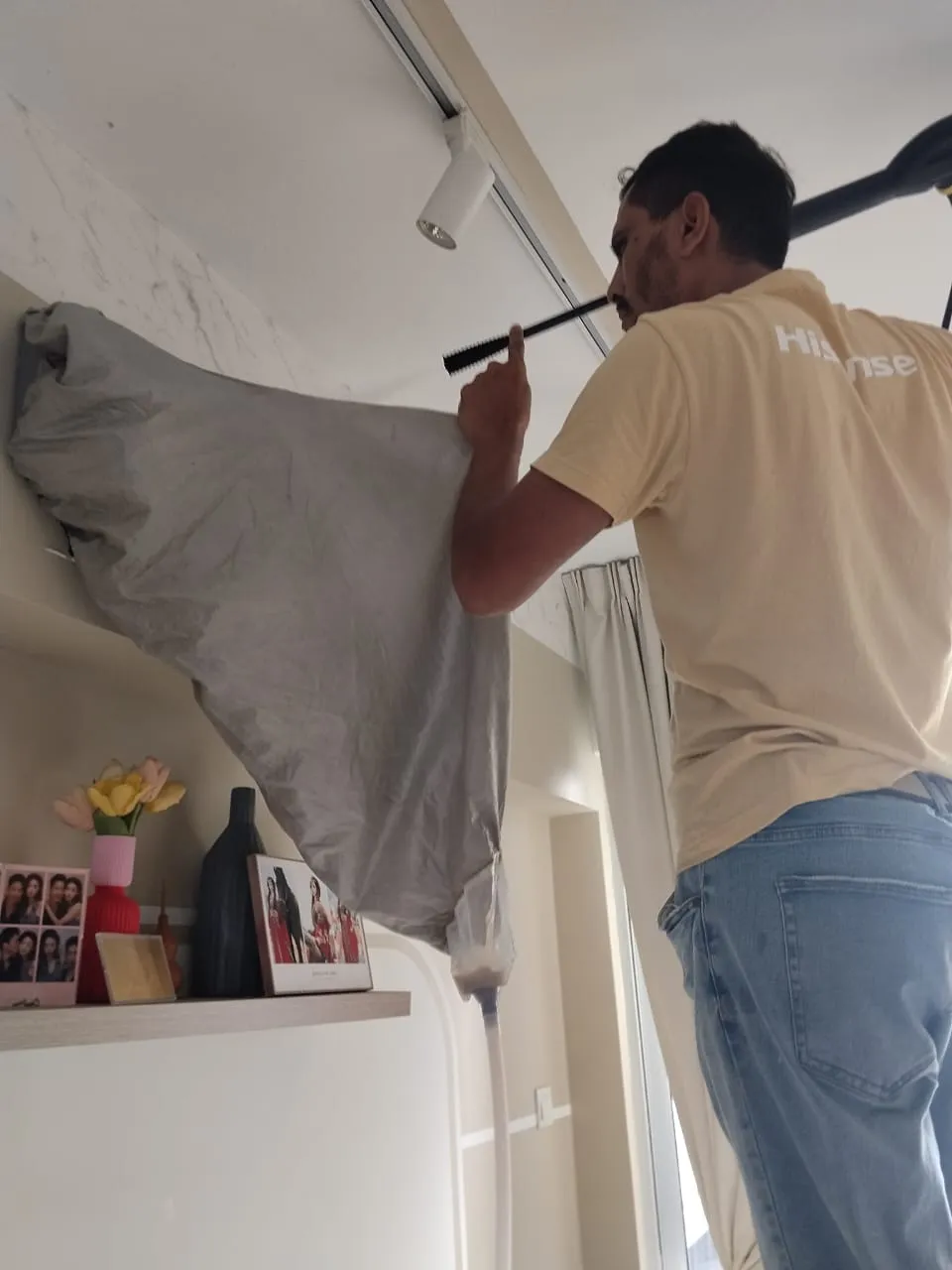
Once the haze clears, here is the sequence a professional post-haze clean follows (this is the same workflow KL Renovator technicians use across KL and Selangor):
- Photo record and filter inspection — the filter's soot load is the fastest indicator of how loaded the internals are.
- Filter deep clean or replacement — rinsed until the water runs clear, or replaced if the mesh is damaged.
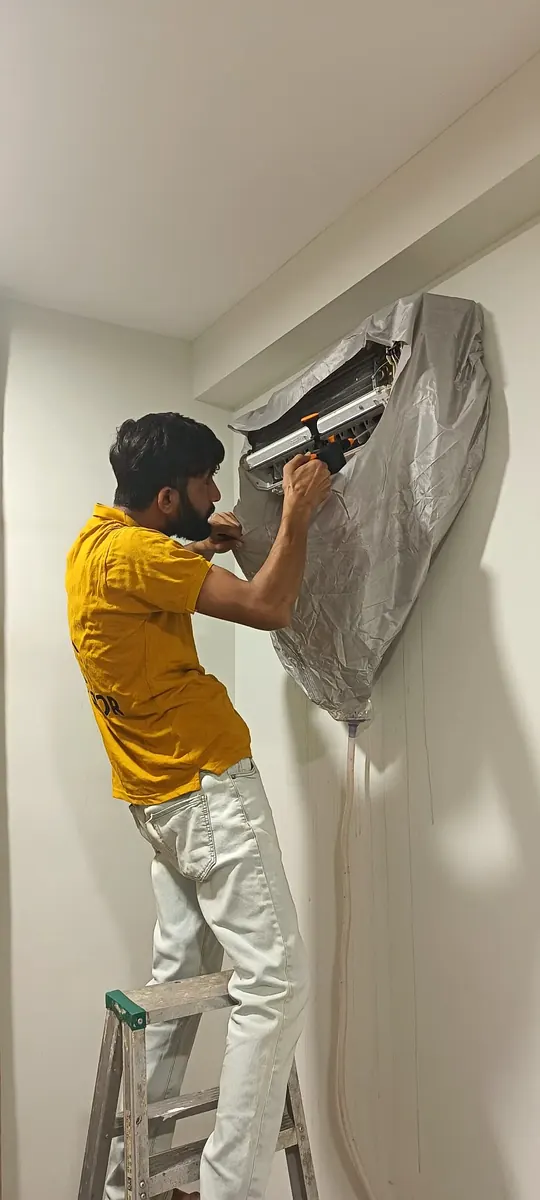
- Evaporator coil check — a high-pressure chemical wash is applied when soot or biofilm is present, with canvas protection on the floor and furniture below.
- Blower wheel cleaning — the fan behind the coil where mould hides.
- Drain pan and drain pipe flush — haze-season humidity accelerates the organic blockage that causes indoor dripping.
- Outdoor condenser fin clean — soot and dust removed from the fins so the unit rejects heat properly again.
- Electrical check and cooling test — connections inspected, the unit run, and cooling performance verified before handover.
- Written job card — what was found, what was done, and the 1-month workmanship warranty terms.
Basic service vs chemical wash vs overhaul after haze
| Your unit's condition after haze | Recommended service | Published price (wall-mounted 1.0–1.5 HP) |
|---|---|---|
| Cools normally, no smell, light dust on the filter | Basic service | From RM 99 |
| Ran heavily through haze; musty smell, weaker airflow, or visible soot on the coil | Pressure chemical wash | From RM 120 |
| Still leaks after washing, ice forms on the pipe, or no deep clean in 3+ years | Chemical overhaul (wall-mounted aircon only) | From RM 420 |
Not sure where your unit sits? Compare the honest DIY line in our DIY cleaning vs professional chemical wash guide, or the chemical wash vs chemical overhaul breakdown. You can also WhatsApp a photo of your filter and unit — we will tell you which level you actually need.
Post-haze prices — KL Renovator's published rates
These are the current published rates in the repository. There is no "haze surcharge": the same prices apply in haze months, and every quote is confirmed in writing via WhatsApp before any work begins.
| Service | Wall-mounted | Ceiling cassette |
|---|---|---|
| Basic servicing | RM 99 (1.0–1.5 HP) · RM 120 (2.0–2.5 HP) · RM 150 (3.0–3.5 HP) | RM 150 (1.0–1.5 HP) · RM 200 (2.0–3.0 HP) · RM 250 (3.5–5.0 HP) |
| Pressure chemical wash | RM 120 (1.0–1.5 HP) · RM 150 (2.0–2.5 HP) · RM 180 (3.0 HP) · RM 200 (4.0–5.0 HP) | RM 220 (1.0–1.5 HP) · RM 280 (2.0–3.0 HP) · RM 350 (4.0–5.0 HP) |
| Chemical overhaul (wall-mounted aircon only) | RM 420 (1.0–1.5 HP) · RM 490 (2.0–2.5 HP) · RM 560 (3.0–3.5 HP) | Separate on-site quote |
Annual maintenance contracts are the easiest way to stop haze season from becoming a problem at all: the AMC Basic plan from RM 299 per unit per year covers 2 basic services and 1 chemical wash; AMC Standard from RM 499 adds a second chemical wash and a free emergency check. Prices are per wall-mounted 1.0–1.5 HP unit; multi-unit and commercial discounts are quoted on enquiry. Booking 5 or more units in one visit also qualifies for the 5% instant booking discount, and 10% for 10 or more.
Timing: before, during and after haze season
Transboundary smoke haze in Malaysia typically peaks from August to October, but fine dust from construction, traffic and local sources is present year-round — a unit on a busy corridor fouls quickly even in haze-free months. The schedule that protects both your comfort and your wallet:
- Before peak haze (July–August): book the annual chemical wash so the coil enters haze season clean.
- During heavy haze days: rinse the filter every 1–2 weeks, keep windows closed, keep the outdoor unit clear.
- After the haze clears: run the unit briefly to dry the internals, then book a post-haze check — a basic service if everything looks light, a chemical wash if the smell or airflow says otherwise.
- AMC customers: nothing to schedule — the contract's visit cycle already covers it, and we send WhatsApp reminders.
For the baseline servicing interval your unit needs regardless of haze, see how often you should service your aircond in Malaysia and the 12-point maintenance checklist.
Local post-haze service coverage in KL & Selangor
KL Renovator handles post-haze cleaning calls across Kuala Lumpur and Selangor, including Petaling Jaya, Shah Alam, Subang Jaya, Puchong, Klang, Ampang, Cheras, Kajang, Mont Kiara, Bangsar, Setapak, Kepong, Batu Caves, Selayang, Rawang, Putrajaya and Cyberjaya. See Aircond Maintenance Kuala Lumpur or Petaling Jaya Aircond Specialist.
Operating hours are Monday to Sunday, 9:00 AM–6:00 PM. Same-day slots are often available depending on technician routing. KL Renovator operates under Multicore Dynamics Resources (SSM 003765188-T), services all 20 brands listed on this website, and covers eligible workmanship with a 1-month written warranty.
Frequently asked questions
Does haze damage aircond units?
Haze does not instantly damage a healthy aircond, but the fine soot it deposits on the filter, coil, blower and outdoor fins adds to the fouling that a normal service schedule already has to remove. The longer a unit runs through heavy haze without filter rinses, the faster airflow and cooling decline and the earlier a chemical wash is needed.
How much haze dust does an aircond collect?
It depends on the unit, run hours and how strong the haze is, so there is no fixed figure. Practical signs are visible: a grey film on the mesh filter within days, weaker airflow, a musty smell, or dust on the outdoor fins. If your filters look dirty every 1 to 2 weeks during haze, the internal parts have likely collected more.
Can I clean my aircond after haze myself?
Rinsing the mesh filters is safe DIY work — do it every 1 to 2 weeks during haze days. Cleaning the evaporator coil, blower wheel, drain path and outdoor condenser properly requires a pressure chemical wash with canvas protection, so leave that part to a technician.
Should I run or switch off my aircond during haze?
Run it with doors and windows closed. A split unit recirculates indoor air and does not pull in outdoor air while the room is sealed, so it keeps the air you already have circulating. Opening windows during a high-PM2.5 day replaces that air with fresh haze. The mesh filter is not a PM2.5 filter — pair the aircond with a HEPA purifier if outdoor smoke is the main concern.
How often should I rinse the filter during haze season?
Every 1 to 2 weeks during heavy haze instead of the usual 2 to 4 weeks. Switch the unit off or unplug it, remove the filters, rinse under running water, shake off excess water, dry completely in shade, and refit. A filter that is reinstalled damp will re-dust the room every time the unit runs.
What post-haze service should I book — basic service or chemical wash?
Book a basic service (from RM 99) if the unit cooled normally during haze and shows no smell. Book a pressure chemical wash (from RM 120 for a wall-mounted 1.0–1.5 HP unit) if it ran a lot through the haze and now smells musty, blows weaker air, or the coil shows heavy soot. A chemical overhaul (wall-mounted units only, from RM 420) is for units that still leak, ice up, or have never been deep-cleaned in 3+ years.
How long does a post-haze chemical wash take?
A wall-mounted unit takes approximately 45 to 90 minutes per unit with canvas protection, filter cleaning, drain flush and a cooling test after completion. Ceiling cassette units typically take 90 to 120 minutes. Same-day slots are often available across KL and Selangor.
Does KL Renovator charge extra during haze season?
No. The same published rates apply — basic servicing from RM 99, pressure chemical wash from RM 120 for a wall-mounted 1.0–1.5 HP unit — and every price is confirmed in writing via WhatsApp before work begins. Multi-unit bookings qualify for the 5% instant booking discount at 5+ units and 10% at 10+ units.
What months does haze season affect aircond cleaning?
Transboundary smoke haze in Malaysia typically peaks from August to October, but dust from construction, traffic and local sources is present year-round, so a unit on a busy corridor fouls fast even in haze-free months. The same post-haze checklist applies whenever fine dust loading is high.
Can KL Renovator service my aircond brand after haze?
Yes. KL Renovator services the 20 brands listed on this website, including Daikin, Panasonic, Mitsubishi, Acson, York, Carrier, Midea, Haier, Toshiba, Hitachi, Samsung, LG, Sharp, Fujitsu, Gree, National, Hisense, Aux, TCL and Isonic, across KL and Selangor.
Book your post-haze clean
The cheapest post-haze service is the one you did before the haze. If the haze is already here: rinse the filter this week, and once it clears, WhatsApp +60 18-298 3573 with your location, unit type and HP for a confirmed price and slot — or use the online booking form. Related: Chemical Deep-Clean · Basic Maintenance Service · Aircond Bad Smell Guide · Fix: Aircond Weak Airflow · aircond diagnostic tools · aircond technician near you in KL & Selangor.
Definitions
Key terms in this guide, explained
Short, plain-language definitions of the terms used above — written by the technicians who do the work, not copied from a manufacturer brochure.
Workmanship cover — what is included, and what is not?
A workmanship warranty covers the labour: if the fault comes back because of how the job was done — a joint that leaks, a drain that was not cleared, a bracket that was not levelled — the contractor returns and fixes it at no charge. The brand warranty is separate and covers manufactured parts such as the compressor or PCB, and it survives only if the unit was installed and serviced correctly.
Get the scope, price and warranty period in one written WhatsApp message before work starts — a verbal promise is not a warranty.
What is a ceiling cassette unit?
A ceiling cassette is recessed into the ceiling and blows air out of two or four sides, which suits square shoplots, meeting rooms and open-plan offices better than a wall unit. Servicing it is a different job: the technician works overhead off a ladder, drops the face panel, and often has to deal with a condensate pump rather than a gravity drain.
Cassette work is priced separately from wall units — chemical wash for a 1.0–1.5 HP cassette starts at RM 220.
What is a chemical overhaul, and when is it needed?
A chemical overhaul is the level above a chemical wash: the indoor unit is dismounted, dismantled into casing, blower wheel, drain tray and coil, and each part is soaked and scrubbed separately before reassembly and a leak test. It is the only way to clear a drain tray that has silted up or a blower wheel packed solid with mould. Published price starts at RM 420 for 1.0–1.5 HP.
Ask for an overhaul instead of another wash if the unit still drips or smells within weeks of a chemical wash.
Side-by-side comparison
Technician vs DIY — where does the line sit?
Some maintenance genuinely belongs to the owner. The rest needs pressure equipment, gauges and an electrical isolation step.
| What to compare | Do it yourself | Book a technician |
|---|---|---|
| Filter washing | Yes — every 2–4 weeks | Included in every visit |
| Coil and blower cleaning | No — spray cans push dirt deeper | Pressure wash with a proper catch bag |
| Anything involving gas or wiring | No | Gauges, isolation, current readings |
| Warranty effect | Damage from DIY is not covered | Workmanship warranty applies |
In short: Wash the filters yourself and check the outdoor unit has clear air; leave anything behind the front panel to someone with gauges.
Quick answer
KL Renovator's practical answer: Haze coats aircond filters and coils in fine PM2.5 dust. What smoke haze does to your unit, and the post-haze cleaning checklist for KL & Selangor homes.
Reader FAQs
Does haze damage aircond units?
Haze does not instantly damage a healthy aircond, but the fine soot it deposits on the filter, coil, blower and outdoor fins adds to the fouling that a normal service schedule already has to remove. The longer a unit runs through heavy haze without filter rinses, the faster airflow and cooling decline and the earlier a chemical wash is needed.
How much haze dust does an aircond collect?
It depends on the unit, run hours and how strong the haze is, so there is no fixed figure. Practical signs are visible: a grey film on the mesh filter within days, weaker airflow, a musty smell, or dust on the outdoor fins. If your filters look dirty every 1 to 2 weeks during haze, the internal parts have likely collected more.
Can I clean my aircond after haze myself?
Rinsing the mesh filters is safe DIY work — do it every 1 to 2 weeks during haze days. Cleaning the evaporator coil, blower wheel, drain path and outdoor condenser properly requires a pressure chemical wash with canvas protection, so leave that part to a technician.
Should I run or switch off my aircond during haze?
Run it with doors and windows closed. A split unit recirculates indoor air and does not pull in outdoor air while the room is sealed, so it keeps the air you already have circulating. Opening windows during a high-PM2.5 day replaces that air with fresh haze. The mesh filter is not a PM2.5 filter — pair the aircond with a HEPA purifier if outdoor smoke is the main concern.
How often should I rinse the filter during haze season?
Every 1 to 2 weeks during heavy haze instead of the usual 2 to 4 weeks. Switch the unit off or unplug it, remove the filters, rinse under running water, shake off excess water, dry completely in shade, and refit. A filter that is reinstalled damp will re-dust the room every time the unit runs.
What post-haze service should I book — basic service or chemical wash?
Book a basic service (from RM 99) if the unit cooled normally during haze and shows no smell. Book a pressure chemical wash (from RM 120 for a wall-mounted 1.0–1.5 HP unit) if it ran a lot through the haze and now smells musty, blows weaker air, or the coil shows heavy soot. A chemical overhaul (wall-mounted units only, from RM 420) is for units that still leak, ice up, or have never been deep-cleaned in 3+ years.
How long does a post-haze chemical wash take?
A wall-mounted unit takes approximately 45 to 90 minutes per unit with canvas protection, filter cleaning, drain flush and a cooling test after completion. Ceiling cassette units typically take 90 to 120 minutes. Same-day slots are often available across KL and Selangor.
Does KL Renovator charge extra during haze season?
No. The same published rates apply — basic servicing from RM 99, pressure chemical wash from RM 120 for a wall-mounted 1.0–1.5 HP unit — and every price is confirmed in writing via WhatsApp before work begins. Multi-unit bookings qualify for the 5% instant booking discount at 5+ units and 10% at 10+ units.
What months does haze season affect aircond cleaning?
Transboundary smoke haze in Malaysia typically peaks from August to October, but dust from construction, traffic and local sources is present year-round, so a unit on a busy corridor fouls fast even in haze-free months. The same post-haze checklist applies whenever fine dust loading is high.
Can KL Renovator service my aircond brand after haze?
Yes. KL Renovator services the 20 brands listed on this website, including Daikin, Panasonic, Mitsubishi, Acson, York, Carrier, Midea, Haier, Toshiba, Hitachi, Samsung, LG, Sharp, Fujitsu, Gree, National, Hisense, Aux, TCL and Isonic, across KL and Selangor.
Reviewed by real technicians
KL Renovator's HVAC Expert Team
This article links back to the same field team that services wall-mounted, ceiling cassette and window units across KL & Selangor. Meet the 4 real technicians behind KL Renovator, see their experience, and review our service standards before you book.