Aircond Gas Top-Up Myths Malaysia — What's True, What's Not
Many Malaysian homeowners have been misled about aircond gas top-ups. This guide busts the most common myths.
Myth 1 — "Gas needs to be topped up every year"
False. A properly installed aircond with no leaks does not lose gas. If your unit needs top-up every year, there is a leak that must be found and repaired first.
Myth 2 — "Any amount of gas is fine"
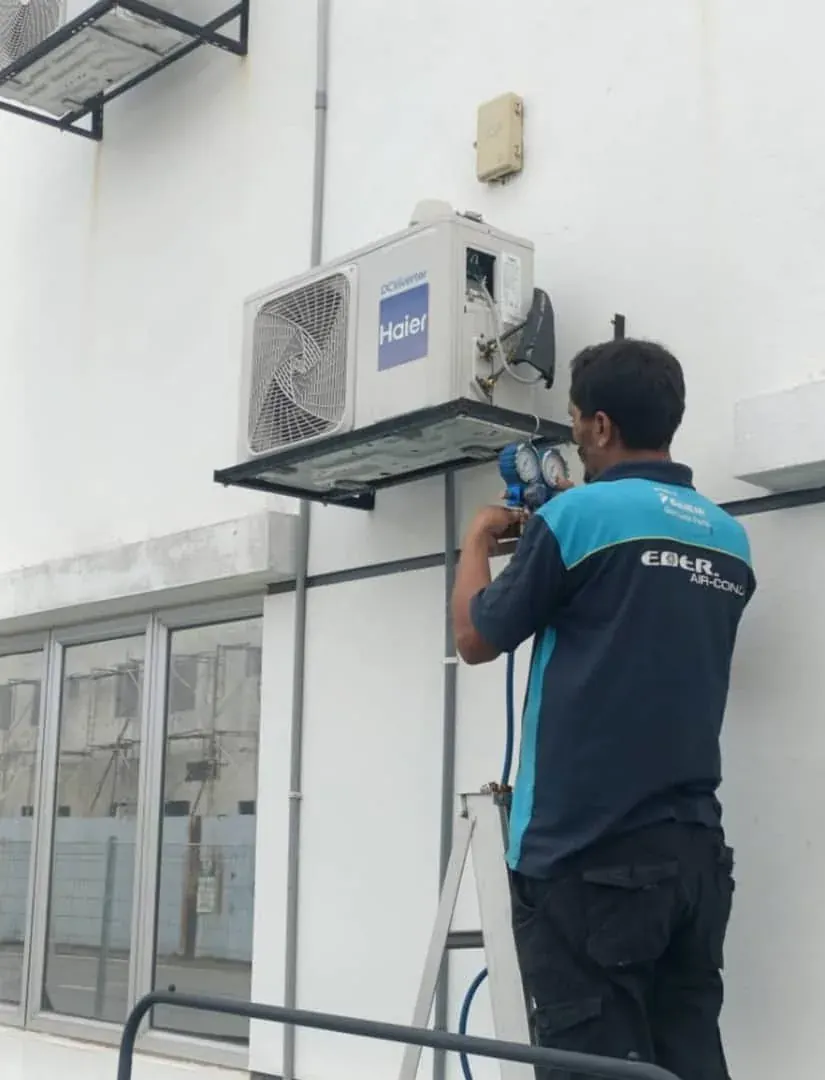
False. Both too little AND too much refrigerant damage the compressor. Professional technicians use a manifold gauge for exact pressure measurement.
Myth 3 — "R22 can be replaced with R410A"
False. R22 and R410A are incompatible. Never mix refrigerant types. Continue using R22 until the unit needs replacement.
Myth 4 — "More gas = colder air"
False. If gas is already at correct pressure, adding more harms the compressor. Always measure first.
Myth 5 — "R32 costs much more"
R32 top-up is slightly higher in cost but uses less volume, so the total difference is smaller than it appears.
What a Proper Gas Top-Up Includes
- Leak check before adding gas
- Current pressure measurement
- Correct amount added
- Final pressure verification
- Cooling performance test
R22 from RM 2.50/PSI, R410A from RM 3.00/PSI, R32 from RM 3.00/PSI. Leak check included. WhatsApp +60 18-298 3573. See: R32/R410A Gas Service | Fix: Aircond Low Gas
How to Know If Your Unit Actually Has Low Gas
The clearest sign is consistently weak cooling across all modes and settings, combined with the outdoor unit compressor running continuously without cycling off. Ice forming on the evaporator coil or copper pipes is a strong indicator of significantly low gas. Warm air blowing from the vents while the fan runs at full speed also suggests the compressor is not achieving adequate pressure differential. These symptoms together almost always indicate low gas or a refrigerant leak — but the only way to confirm is with a manifold gauge measurement. Never top up based on symptoms alone without pressure verification.
R22 from RM 2.50/PSI, R410A from RM 3.00/PSI, R32 from RM 3.00/PSI. Leak check always included. WhatsApp +60 18-298 3573.
What a Legitimate Gas Top-Up Looks Like
A professional gas top-up takes 45–60 minutes. The technician arrives with a manifold gauge set and refrigerant cylinder, connects the gauges to the service valves, reads current suction and discharge pressure, compares to manufacturer specifications for the ambient temperature, and only then adds refrigerant if the pressure is confirmed below specification. The gauge readings before and after are shown to you. If any technician proposes to top up gas in 10 minutes without connecting gauges, this is not a professional service. Always ask to see the gauge readings before and after any gas work.
Definitions
Key terms in this guide, explained
Short, plain-language definitions of the terms used above — written by the technicians who do the work, not copied from a manufacturer brochure.
Flare connection — what is sealing the refrigerant in?
A flare joint is the cone-shaped end formed on soft copper tubing so it can seal metal-to-metal against the unit's service valve under a flare nut. The cone must be cut square, deburred and torqued to spec. Over-tightening cracks it, under-tightening leaks slowly — which is why most refrigerant loss on a young system is found at a flare, not in the coil.
A soap-bubble test on every flare after commissioning takes two minutes and catches the leak before it costs you a top-up.
What is PSI, and what should the reading be?
PSI is pounds per square inch, the pressure reading the technician works to when charging. Each refrigerant has its own running-pressure window — roughly 60–70 PSI for R22, 120–140 for R410A and 130–150 for R32 on the suction side at Malaysian ambient temperatures. Charging by PSI is why gas top-up is billed per PSI rather than as a flat fee.
Ask for the before-and-after pressure readings on the invoice; that single line makes an over-charge or an invented top-up obvious.
What are the clearance rules for an outdoor unit?
The outdoor unit holds the compressor, the condenser coil and the fan that blows heat away from the coil. It can only reject heat if air moves freely through the fins, so a coil packed with dust, a unit boxed into a tight service yard, or a hot wall right behind it all raise running pressure and electricity use.
Leave at least 30 cm of clear air behind the condenser and never enclose it in a sealed cabinet or grille box.
Side-by-side comparison
R32 vs R410A: how do the two refrigerants compare?
You do not choose the refrigerant — the unit does. What matters is knowing which one you have before anyone opens a valve.
| What to compare | R32 | R410A |
|---|---|---|
| Found in | Most units sold in Malaysia today | Mid-generation inverters, roughly 2010–2018 |
| Composition | Single component — can be topped up | Blend — a big leak is better recovered and recharged |
| Global warming potential | About a third of R410A | Higher |
| Published top-up price | RM 3.00 / PSI | RM 3.00 / PSI |
In short: Never let anyone substitute one for the other in an existing system; retrofitting the wrong gas costs a compressor, not a top-up.
Quick answer
KL Renovator's practical answer: Many Malaysian homeowners have been misled about aircond gas top-ups. This guide busts the most common myths.
Reviewed by real technicians
KL Renovator's HVAC Expert Team
This article links back to the same field team that services wall-mounted, ceiling cassette and window units across KL & Selangor. Meet the 4 real technicians behind KL Renovator, see their experience, and review our service standards before you book.