Aircond Dismantle & Reinstall Guide for Moving House
Moving house in KL or Selangor? Learn professional aircond dismantling, refrigerant pump-down, upright transport and correct reinstallation — plus when old copper pipes can be reused.
If you are moving house in Kuala Lumpur or Selangor, the aircond is one of the easiest things to damage — and one of the most expensive to replace. A general mover can lift a box. They should not cut copper pipes, open service valves, or tip the outdoor unit onto its side.
What is professional aircond dismantling?
Professional aircond dismantling is the controlled removal of a split-unit indoor unit and outdoor condenser so the system can be moved or stored without losing refrigerant, flooding the compressor with oil, or damaging the flare joints.
It is not the same as a chemical overhaul (where the indoor unit is opened for deep cleaning) and it is not a new-unit installation. It is a relocation workflow: recover the gas, isolate the power, remove both units, protect them in transit, then recommission at the new address.
KL Renovator handles this as a dedicated Dismantle & Shift Service across KL and Selangor — from landed houses in Shah Alam and Kajang to condos in Petaling Jaya, Subang Jaya, Cheras and Ampang.
Why you should not let movers cut the pipes
The copper line-set between the indoor and outdoor units is a sealed refrigerant circuit. If someone cuts the pipes without a pump-down:
- R32, R410A or R22 vents into the air — you lose the charge and may need a Aircond Gas Refill later
- Moisture and air enter the circuit, which is hard on the compressor
- Oil can leave the outdoor unit, leaving the compressor poorly lubricated on the next start-up
- Open pipe ends collect dust and metal swarf during the move
That is why “cheap dismantle” often becomes an expensive reinstall. The unit looks intact, but it no longer cools properly after the move.
Step-by-step: how a technician dismantles a split unit
1. Site check and photo record
Before any tool comes out, the technician notes the brand, HP, refrigerant type on the outdoor nameplate, pipe route, isolator location, and outdoor bracket condition. Photos help match the new-site layout later — especially in condos where the outdoor ledge is already fixed.
2. Refrigerant pump-down (recovery into the outdoor unit)
On a typical split unit, the refrigerant can be pumped back into the outdoor condenser. The unit is run in cooling, the liquid service valve is closed so gas is compressed into the outdoor unit, then the suction valve is closed. The charge stays inside the condenser during transport.
You should not need a routine top-up just because you moved. Refrigerant does not “get used up” during a correct dismantle. A top-up is only discussed if the system was already low or a leak is found — see our dismantling and installation price guide for how that is quoted separately.
3. Electrical disconnection
Power is isolated at the aircond isolator or MCB and verified dead before the indoor and outdoor wiring is disconnected. Cables are labelled. Nobody should pull a live indoor unit off the wall or leave exposed conductors in a condo riser.
If the old house used a shared socket instead of a dedicated isolator, that is flagged. The new home may need a proper isolator — quoted before work, not after the holes are drilled.
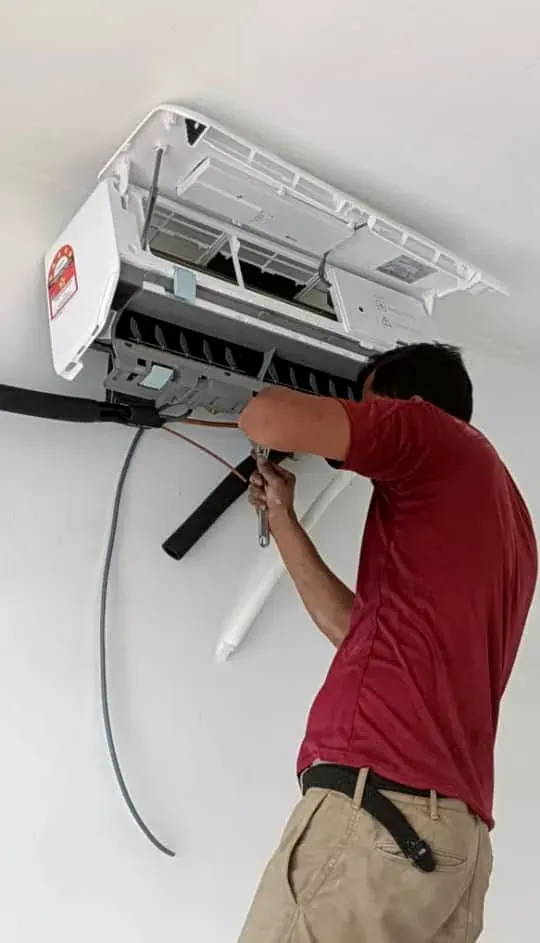
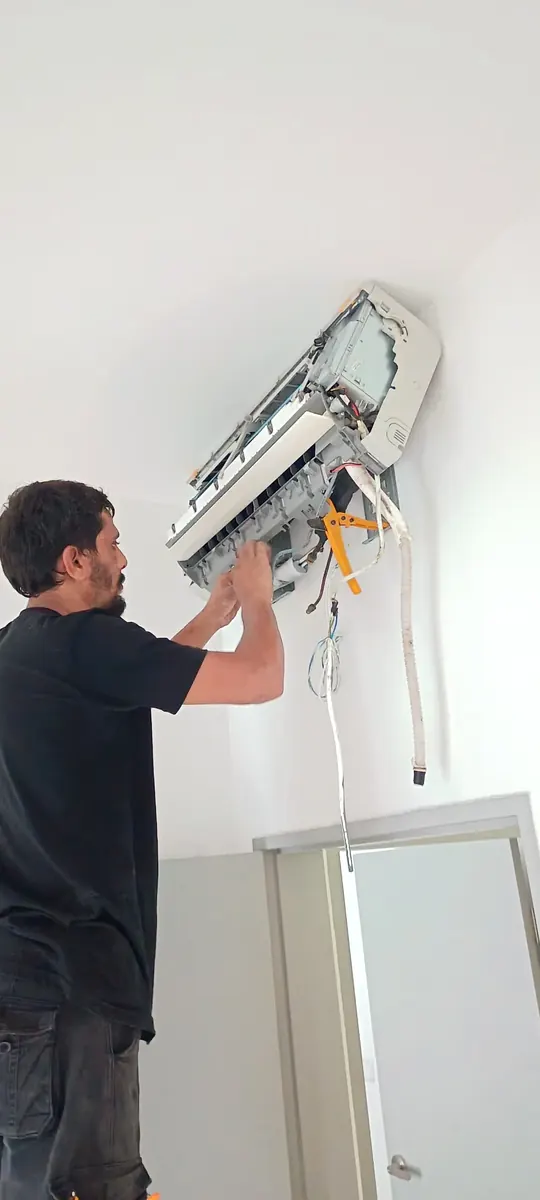
4. Indoor unit removal
The front is secured, the indoor unit is unclipped from the wall plate, and the remaining pipe stubs are capped. The wall plate usually stays behind — it is screwed into the old wall and is not worth relocating.
5. Outdoor unit and pipe extraction
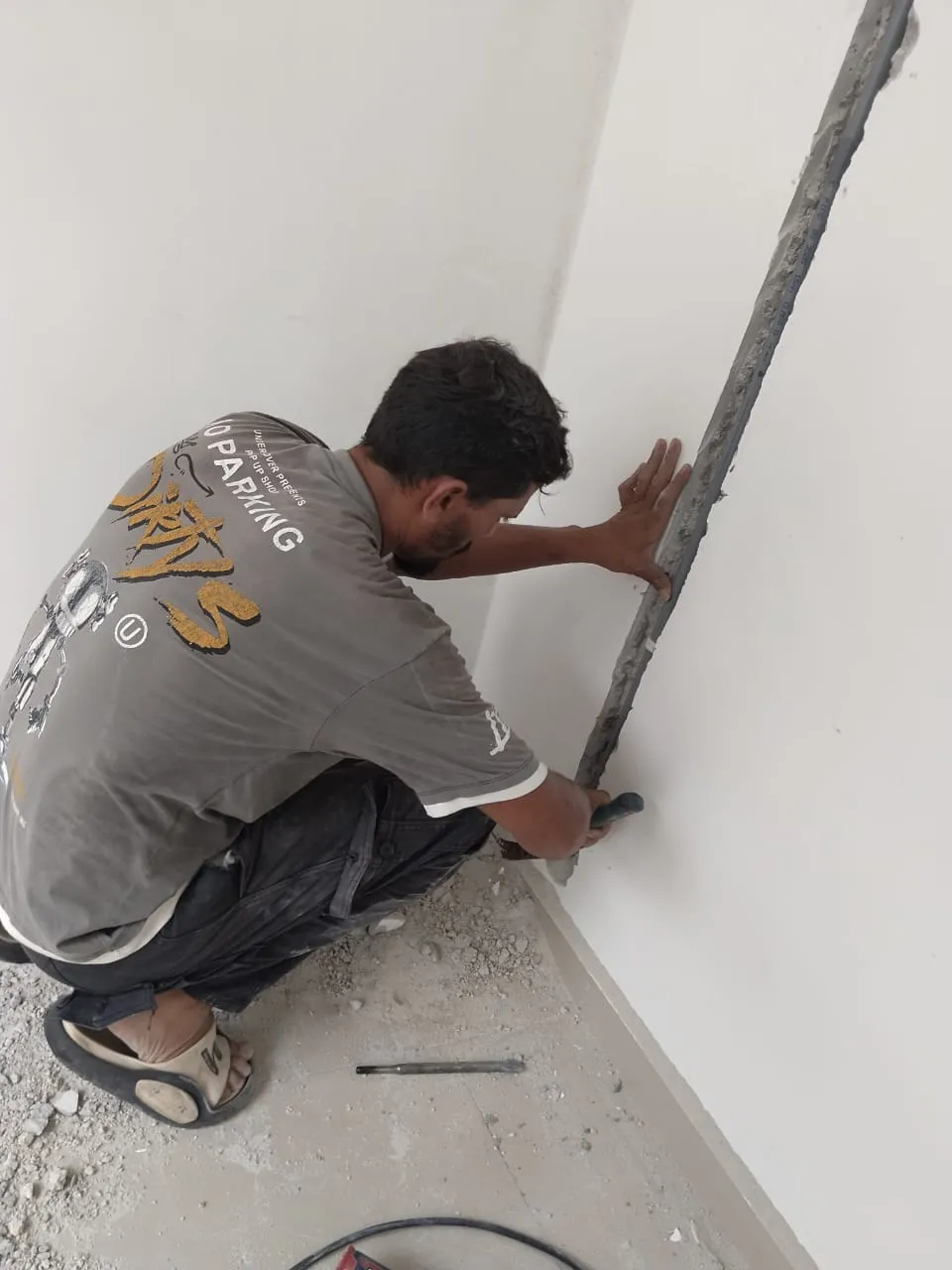
The outdoor condenser is unbolted from the bracket or ledge. Copper pipes that pass through the wall are cut at the penetration. Those buried lengths cannot be pulled out intact, so they stay in the old wall.
Both units are wrapped. The outdoor unit is kept upright. That last point matters more than most homeowners realise.
Transport: treat the outdoor unit like a compressor, not a suitcase
The outdoor unit contains the compressor and a sump of lubricating oil. If it lies on its side in a lorry, oil can migrate into the refrigerant pipes. The next start-up may then run the compressor with poor lubrication.
- Keep the outdoor unit upright at all times
- Do not stack boxes or a second condenser on top of it
- Pad the fins — they bend easily and reduce airflow if crushed
- Keep the indoor coil and blower covered so dust does not enter during the move
For a same-building shift (for example, another unit in the same PJ or Subang condo), this is a short carry. For a different-address move across the Klang Valley — Cheras to Shah Alam, Ampang to Puchong, Selayang to Kajang — the units travel in the technician’s vehicle with padding, not in an open mover lorry if we can avoid it.
Can existing copper piping be reused?
This is the question that decides both cost and reliability. The honest answer: it depends on where you are going, not on how new the pipes look.
| Situation | Reuse old copper? | Why |
|---|---|---|
| Moving to a new house or condo | No | Pipes are cut and left in the old wall. New 7ft copper, insulation, wire and drain are installed at the new site. |
| Repositioning in the same room after renovation | Sometimes | Only if pipe diameter matches the HP, flares are sound, insulation is intact, and the circuit is clean. |
| Replacing a burnt compressor on the same pipes | Usually no | Old pipes can hold moisture, acid and debris from the failed compressor. |
| Window unit move | Not applicable | No split copper line-set. Still isolate power and protect the chassis. |
Even when a same-site reuse looks possible, a technician should still inspect pipe size (1.0–1.5 HP is not the same as 2.5–3.0 HP), insulation thickness, oil residue and kinks. If the line is wrong, new copper is cheaper than a compressor later. Extra pipe beyond the included 7ft is charged at the published rates: RM 17/ft (1.0–1.5 HP), RM 23/ft (2.0–2.5 HP), RM 27/ft (3.0–3.5 HP).
For longer runs at the new house, also read our maximum piping distance guide before you pick an outdoor ledge that is “just around the corner”.
Reinstallation at the new address
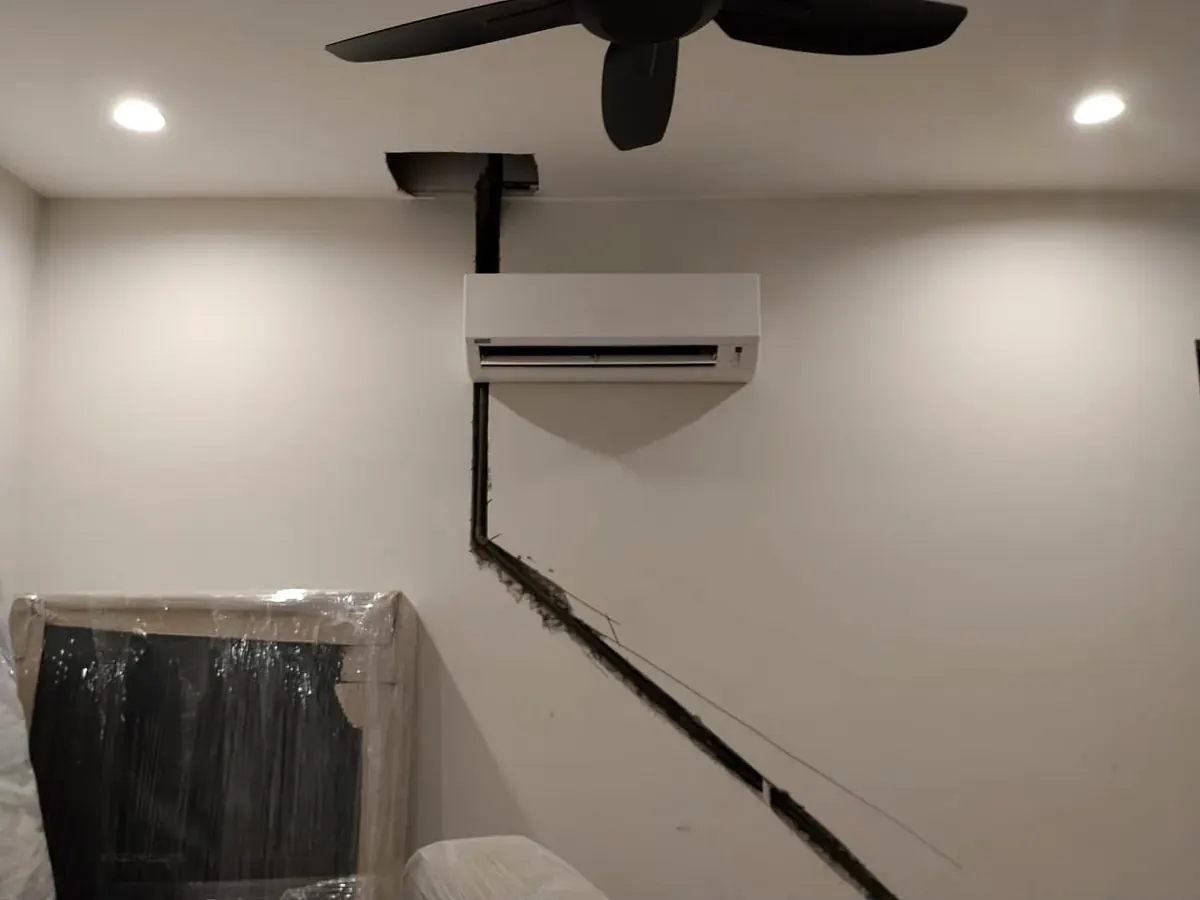
Reinstallation is a full install, not a “put it back on the wall” job. The stored refrigerant is only released after the new line-set is clean and dry.
- Survey the new wall, drain path and outdoor position — brick, concrete or plasterboard need different anchors. Condo ledges are often already decided by the building.
- Mount indoor plate and outdoor bracket — new brackets stay at the new site. A standard outdoor bracket is RM 45; heavy-duty is RM 70 if quoted.
- Run new copper, insulation, electrical wire and drain — 7ft of each is included with reinstallation. Drain must fall continuously so condensate does not back up into the indoor unit.
- Vacuum the new circuit — air and moisture are pulled out before the service valves are opened. Skipping this step is one of the most common cheap-install shortcuts.
- Open the valves and release the stored refrigerant — the same charge that was pumped down should return to the system.
- Test and handover — cooling, airflow, drain flow, isolator, and a written job card.
The physical mounting steps match a careful Split Unit Install. The difference is that your existing indoor and outdoor units are being recommissioned, not a brand-new boxed set.
What should be tested after reinstallation?
Do not accept “it’s on, so it’s fine.” After a move, ask the technician to confirm:
- Indoor unit blows clearly colder air after a few minutes, not just room-temperature breeze
- Outdoor fan and compressor both run
- No hissing at the flare joints
- Drain water leaves the indoor unit and does not drip down the wall
- Isolator works and the MCB does not trip
- Remote and all fan speeds respond
If cooling is weak after a correct pump-down and vacuum, the unit may already have had a leak or a dirty coil before the move. That is diagnosed and quoted separately — not hidden inside the relocation price.
How long does dismantle and reinstall take?
| Job | Typical time | Notes |
|---|---|---|
| Dismantle only | About 1 hour per split unit | Pump-down, isolate, remove, cap and pack |
| Same building / nearby reinstall | About 3–4 hours door to door | Common in condos when you change units in the same block |
| Different address in KL / Selangor | About 4–5 hours including travel | Two site visits in one day if keys are ready |
| Two split units | About 6–8 hours | Usually booked as one full-day job |
High-floor condos add lift booking and working-hour limits. That is scheduling, not a reason to skip vacuuming. See also how long aircond installation takes.
KL Renovator dismantle and reinstall pricing
These are the published KL Renovator rates. Final price still depends on HP, pipe length, access and whether the new site needs extra electrical or bracket work. Everything is confirmed on WhatsApp before work starts.
| Package | From | Includes |
|---|---|---|
| Dismantle only (indoor + outdoor) | RM 90 | Pump-down, safe removal, pipe protection. No reinstall. |
| Dismantle + reinstall, same place / nearby (standard) | RM 250 | Typical 1.0–1.5 HP wall-mounted move in the same building or nearby |
| Dismantle + reinstall, same place (2.0–2.5 HP) | RM 290 | Larger wall-mounted split |
| Dismantle + reinstall, other place | RM 350 | Different address. 1.0–1.5 HP package as published |
Full relocation packages include refrigerant pump-down, dismantle, transport, new 7ft copper pipe, insulation, electrical wire, drain pipe, vacuum commissioning and a cooling test. Beyond 7ft: copper as above, electrical wire RM 9/ft, insulation RM 7/ft, drain RM 5/ft. High-rise or difficult access, if needed, is RM 50–150 and is quoted first.
A brand-new install, if you decide not to move the old unit, starts from RM 199 for a wall-mounted 1.0–1.5 HP unit. Compare both options on the aircond installation KL page.
Common mistakes when moving an aircond
- Asking the lorry crew to “just unscrew it” — they will cut pipes and leave the circuit open
- Laying the outdoor unit flat — compressor oil moves into the pipes
- Reusing cut or undersized copper at the new house — leaks and weak cooling follow
- Skipping the vacuum — moisture left in a newly joined line-set is a compressor risk
- No drain fall on the new wall — the unit then drips two days after you move in
- No isolator at the new site — unsafe and often against condo electrical rules
- Moving a dying R22 unit “to save money” — you may spend RM 350 relocating a unit that needs a compressor soon
Condo, JMB and landed-house notes in KL & Selangor
Rules are not the same in every building. Confirm with your JMB, MC or management office before moving day.
- Many condos in Mont Kiara, Bangsar, Damansara, PJ and Subang require contractor registration at the guardhouse
- Working hours are often weekdays 9am–5pm; Saturday mornings vary
- Outdoor units usually must sit on the designated AC ledge, not a common corridor
- High floors may need a service-lift booking for the outdoor condenser
- Landed houses in Klang, Shah Alam, Kajang and Puchong are simpler, but you still need a legal isolator and a drain that does not dump onto a neighbour’s wall
Building rules change. Do not treat this list as a universal Malaysian law. Ask management, then send us the condo name on WhatsApp so the visit can be planned. More detail is in our condo installation rules guide.
Should you relocate the old unit or buy a new one?
Relocate if the unit is a working inverter, roughly under 8 years old, and has been serviced. A typical move costs RM 250–350. A replacement indoor/outdoor set plus install is a much larger bill.
Think harder about replacement if the unit is 8+ years old, uses R22, already needs repeated gas top-ups, or has a noisy compressor. Moving a failing unit only relocates the next repair. We do both relocation and new installation, so the recommendation is based on the unit in front of us — not on selling a box.
Frequently asked questions
How much does aircond dismantle and reinstallation cost in Malaysia?
KL Renovator publishes dismantle-only from RM 90, same-place / nearby reinstall from RM 250 (standard) or RM 290 (2.0–2.5 HP), and a different-address package from RM 350 for 1.0–1.5 HP. Extra pipe, wire, brackets and difficult access are quoted before work.
Will I lose gas if I move my aircond?
Not if a pump-down is done correctly. The refrigerant is stored in the outdoor unit and released after the new pipes are vacuumed. You only discuss a top-up if the system was already leaking.
Can old copper pipes be reused?
Not when you leave the old house — those pipes stay in the wall. At a same-site reposition, reuse is possible only if size, cleanliness and insulation are still correct. When in doubt, run new copper.
Can I dismantle the aircond myself?
Homeowners should not open refrigerant valves or cut charged pipes. Electrical isolation and compressor oil control are easy to get wrong. Book a technician for the gas and power steps even if you want to handle boxes yourself.
How long does a house-move reinstall take?
One wall-mounted split is typically 3–4 hours in the same building and 4–5 hours between two Klang Valley addresses, assuming keys and condo access are ready.
Do condos require JMB approval to reinstall an aircond?
Often yes — especially for drilling, outdoor placement and contractor registration. Confirm with your building. There is no single national condo rule.
What if the outdoor unit was already transported on its side?
Tell the technician before start-up. The unit may need to stand upright so oil can settle. Starting immediately after a long sideways trip is a common way to stress the compressor.
Is same-day dismantle and reinstall possible?
Yes for most KL and Selangor moves if both sites are accessible the same day. WhatsApp +60 18-298 3573 with both addresses and your key collection time.
Does reinstallation include vacuuming?
Yes. A relocation package that skips vacuuming is not a complete job. Moisture left in new joints is one reason moved units fail early.
Will I need a gas top-up after moving?
Normally no. If cooling is weak after a proper pump-down and vacuum, the leak or another fault should be found first. Top-up prices are published separately: R22 at RM 2.50/PSI, R410A and R32 at RM 3.00/PSI.
Can ceiling cassette units be moved?
Yes, but access, hanging rods and ceiling panels add time. Ask for a site-specific quote rather than assuming the wall-mounted package price.
Is there a warranty after reinstallation?
Eligible KL Renovator relocation workmanship is covered by a 1-month workmanship warranty. Pre-existing faults on an old unit are not the same thing as an installation defect.
Book dismantle and reinstallation before moving day
The cleanest house moves book the aircond team to the old address in the morning and the new address the same afternoon. Send both locations, unit count, HP if you know it, and whether the new place is a condo or landed house.
WhatsApp +60 18-298 3573 or use the online booking form. Related reading: Dismantle & Relocation · installation guide · aircond technician near you in KL & Selangor.
Definitions
Key terms in this guide, explained
Short, plain-language definitions of the terms used above — written by the technicians who do the work, not copied from a manufacturer brochure.
Chemical overhaul — what is dismantled?
A chemical overhaul is the level above a chemical wash: the indoor unit is dismounted, dismantled into casing, blower wheel, drain tray and coil, and each part is soaked and scrubbed separately before reassembly and a leak test. It is the only way to clear a drain tray that has silted up or a blower wheel packed solid with mould. Published price starts at RM 420 for 1.0–1.5 HP.
Ask for an overhaul instead of another wash if the unit still drips or smells within weeks of a chemical wash.
What is a gas top-up, and does it fix the fault?
A gas top-up restores refrigerant pressure in a system that has lost charge. The technician reads the outdoor unit sticker for the gas type, connects a manifold gauge, checks static and running pressure, then charges by PSI to the manufacturer's target. Refrigerant sits in a sealed loop, so a system that needs topping up has a leak somewhere — the charge is a symptom, not the cure. R32 is priced at RM 3.00 / PSI.
If the same unit needs gas twice in a year, pay for leak detection and repair (RM 120 / leak) instead of a third top-up.
What is the HP rating on an aircond?
HP is the informal Malaysian shorthand for cooling capacity, carried over from compressor horsepower. In practice 1.0 HP ≈ 9,000 BTU/h, 1.5 HP ≈ 12,000 BTU/h, 2.0 HP ≈ 18,000 BTU/h and 2.5 HP ≈ 24,000 BTU/h. Service, chemical wash and installation prices are all quoted against these bands, which is why the technician asks for HP before quoting.
HP is printed on the indoor unit's side label and on the outdoor nameplate — check there rather than guessing from room size.
Side-by-side comparison
Repair vs replace: when is a new unit the cheaper decision?
Use age, the part that failed and the repair-to-replacement ratio — not how the unit looks.
| What to compare | Repair the existing unit | Replace with a new unit |
|---|---|---|
| Unit age | Under 7 years | Over 10 years, or R22 |
| Failed part | Capacitor, sensor, fan motor, drain pump | Compressor or corroded coil |
| Cost signal | Repair under about half a new install | Repair approaching a new install |
| Electricity | Unchanged | Modern inverter cuts long-run consumption |
In short: Get a diagnostic first (RM 88) so the decision rests on a measured fault instead of a guess — the fee is trivial next to a wrong replacement.
Quick answer
KL Renovator's practical answer: Moving house in KL or Selangor? Learn professional aircond dismantling, refrigerant pump-down, upright transport and correct reinstallation — plus when old copper pipes can be reused.
Reader FAQs
What is professional aircond dismantling?
Professional aircond dismantling is the controlled removal of a split-unit indoor unit and outdoor condenser so the system can be moved or stored without losing refrigerant, flooding the compressor with oil, or damaging the flare joints.
Can existing copper piping be reused?
This is the question that decides both cost and reliability. The honest answer: it depends on where you are going, not on how new the pipes look. Situation Reuse old copper? Why Moving to a new house or condo No Pipes are cut and left in the old wall.
What should be tested after reinstallation?
Do not accept “it’s on, so it’s fine.” After a move, ask the technician to confirm: Indoor unit blows clearly colder air after a few minutes, not just room-temperature breeze Outdoor fan and compressor both run No hissing at the flare joints Drain water leaves the indoor unit and does not drip down the wall Isolator…
How long does dismantle and reinstall take?
Job Typical time Notes Dismantle only About 1 hour per split unit Pump-down, isolate, remove, cap and pack Same building / nearby reinstall About 3–4 hours door to door Common in condos when you change units in the same block Different address in KL / Selangor About 4–5 hours including travel Two site visits in one…
Should you relocate the old unit or buy a new one?
Relocate if the unit is a working inverter, roughly under 8 years old, and has been serviced. A typical move costs RM 250–350. A replacement indoor/outdoor set plus install is a much larger bill.
Reviewed by real technicians
KL Renovator's HVAC Expert Team
This article links back to the same field team that services wall-mounted, ceiling cassette and window units across KL & Selangor. Meet the 4 real technicians behind KL Renovator, see their experience, and review our service standards before you book.