Inverter vs Non-Inverter Aircond Service Guide Malaysia 2026
Inverter and non-inverter airconds need different servicing approaches. Learn the key differences in chemical wash frequency, gas top-up, electrical checks, and why skipping proper service costs more in the long run.
Inverter vs Non-Inverter: Why Your Service Approach Should Differ
Most Malaysian households now own at least one inverter aircond — Daikin, Panasonic, Mitsubishi, Samsung, LG, and Midea all sell inverter models as their primary range. But many homeowners still service their inverter units the same way they serviced their old non-inverter units. This is a mistake that can shorten your compressor's lifespan and waste electricity.
Key Technical Differences That Affect Servicing
| Feature | Inverter | Non-Inverter |
|---|---|---|
| Compressor speed | Variable — runs continuously at adjusted speed | Fixed — cycles ON/OFF repeatedly |
| Refrigerant type | Usually R32 (newer) or R410A | Usually R22 (phasing out) or R410A |
| PCB board | Complex inverter PCB — sensitive to voltage and moisture | Simple contactor — more tolerant |
| Energy efficiency | 30–50% less electricity | Higher running cost |
| Typical lifespan | 10–15 years with proper maintenance | 7–12 years |
Chemical Wash Frequency: Inverter Needs More Attention
Inverter units run their compressor continuously at varying speeds rather than cycling on/off. This means the evaporator coil is always active and always collecting dust, mould, and biofilm. A dirty coil on an inverter unit doesn't just reduce cooling — it forces the inverter PCB to ramp up compressor speed to compensate, which increases electricity consumption by 15–30% and puts extra stress on the most expensive component in the system.
- Inverter units: Chemical wash recommended every 10–12 months in Malaysian conditions. Heavy-use units (8+ hours daily) should consider chemical wash every 8 months.
- Non-inverter units: Chemical wash every 12–18 months is usually sufficient because the compressor rest periods give the coil some recovery time.
Gas Top-Up: R32 vs R22 vs R410A
The refrigerant type in your unit determines how gas top-up is handled:
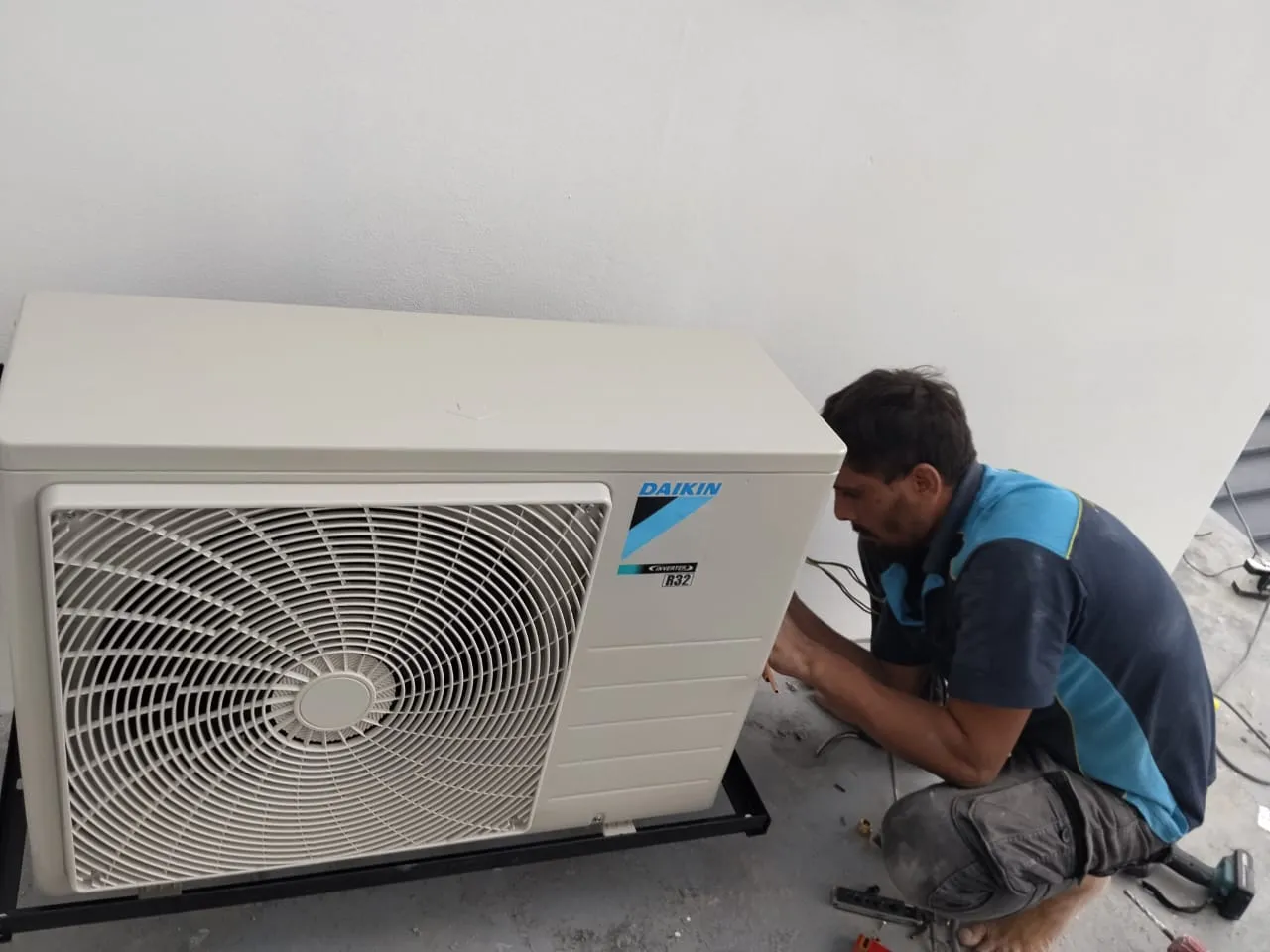
- R32 (most new inverters): Lower global warming potential, requires precise charging. Overcharging by even 10% reduces efficiency. Must be charged by weight, not just pressure reading.
- R410A (older inverters and some non-inverters): Higher operating pressure. Needs proper recovery before recharging. Still widely available.
- R22 (old non-inverters): Being phased out globally. Getting more expensive. If your unit uses R22, consider budgeting for a replacement unit within the next 2–3 years.
KL Renovator's technicians carry R32 and R410A on every van. If your unit uses R22, we stock it but will advise you honestly about replacement timing.
Electrical Checks: Why Inverter Units Need Extra Care
Inverter airconds have a sophisticated PCB (Printed Circuit Board) that controls compressor speed, fan speed, and temperature regulation. This PCB is sensitive to:
- Voltage fluctuations: Malaysia's grid can spike during thunderstorms. A surge protector is recommended for inverter units.
- Moisture ingress: A blocked drain pipe can cause water to reach the PCB compartment. During every service, the technician should check the drain pipe integrity.
- CAPACITOR degradation: Inverter units use multiple capacitors (compressor, fan, PCB filter). These degrade over time and should be tested during every service visit.
Common Mistakes When Servicing Inverter Units
- Using high-pressure water directly on the PCB area: Inverter indoor units have the PCB board inside the indoor casing. Chemical wash must be done carefully to avoid water reaching the electronics.
- Skipping vacuum evacuation after gas top-up: Air and moisture in the refrigerant line damage the inverter compressor over time. Proper vacuum is mandatory.
- Ignoring error codes: Inverter units display error codes on the LED panel. These codes tell the technician exactly what's wrong — but only if they check.
- Using R22 procedures on R32 units: R32 is mildly flammable and requires different handling. Only use technicians trained for R32.
Recommended Service Schedule for Malaysian Homes
| Service Type | Inverter | Non-Inverter |
|---|---|---|
| Basic servicing | Every 3–4 months | Every 4–6 months |
| Chemical wash | Every 8–12 months | Every 12–18 months |
| Chemical overhaul | Every 2–3 years | Every 3–4 years |
| Gas check | Every service visit | Every service visit |
| PCB diagnostic | Every service visit | N/A (simple contactor) |
Pricing: Same for Both Types
KL Renovator charges the same rate regardless of whether your unit is inverter or non-inverter:
- Basic servicing: from RM 99
- Chemical wash: from RM 120
- Chemical overhaul (Wall-Mounted Aircon only): from RM 420
- Gas top-up (R32/R410A): from RM 3.00/PSI
No hidden surcharge for inverter units. All prices confirmed before work starts.
Book Your Service
WhatsApp +60 18-298 3573 with your unit brand, model (inverter or non-inverter), and location. We'll confirm the right service and available slot. Same-day available Mon–Sun across all KL & Selangor.
See also: Basic Maintenance Service | Chemical Deep-Clean | Aircond Gas Refill | Cuci Aircond KL landing
Definitions
Key terms in this guide, explained
Short, plain-language definitions of the terms used above — written by the technicians who do the work, not copied from a manufacturer brochure.
Condensate drainage — what is it, and what blocks it?
Every cooling coil pulls litres of water out of humid Malaysian air each day. That water collects in the drain tray and leaves through a gravity drain pipe. Slime from the coil, dust and insects gradually narrow the pipe until water backs up over the tray lip and drips down your wall. Nine out of ten indoor water leaks are a blocked drain, not a refrigerant fault.
Before booking a repair, check whether the outdoor end of the drain pipe is still dripping while the unit runs — no drip means a blockage.
What is PSI, and what should the reading be?
PSI is pounds per square inch, the pressure reading the technician works to when charging. Each refrigerant has its own running-pressure window — roughly 60–70 PSI for R22, 120–140 for R410A and 130–150 for R32 on the suction side at Malaysian ambient temperatures. Charging by PSI is why gas top-up is billed per PSI rather than as a flat fee.
Ask for the before-and-after pressure readings on the invoice; that single line makes an over-charge or an invented top-up obvious.
What is refrigerant top-up work on a home aircond?
A gas top-up restores refrigerant pressure in a system that has lost charge. The technician reads the outdoor unit sticker for the gas type, connects a manifold gauge, checks static and running pressure, then charges by PSI to the manufacturer's target. Refrigerant sits in a sealed loop, so a system that needs topping up has a leak somewhere — the charge is a symptom, not the cure. R32 is priced at RM 3.00 / PSI.
If the same unit needs gas twice in a year, pay for leak detection and repair (RM 120 / leak) instead of a third top-up.
Side-by-side comparison
R32 vs R410A: what changes for servicing and cost?
You do not choose the refrigerant — the unit does. What matters is knowing which one you have before anyone opens a valve.
| What to compare | R32 | R410A |
|---|---|---|
| Found in | Most units sold in Malaysia today | Mid-generation inverters, roughly 2010–2018 |
| Composition | Single component — can be topped up | Blend — a big leak is better recovered and recharged |
| Global warming potential | About a third of R410A | Higher |
| Published top-up price | RM 3.00 / PSI | RM 3.00 / PSI |
In short: Never let anyone substitute one for the other in an existing system; retrofitting the wrong gas costs a compressor, not a top-up.
Quick answer
KL Renovator's practical answer: Inverter and non-inverter airconds need different servicing approaches. Learn the key differences in chemical wash frequency, gas top-up, electrical checks, and why skipping proper service costs more in the long run.
Reviewed by real technicians
KL Renovator's HVAC Expert Team
This article links back to the same field team that services wall-mounted, ceiling cassette and window units across KL & Selangor. Meet the 4 real technicians behind KL Renovator, see their experience, and review our service standards before you book.